
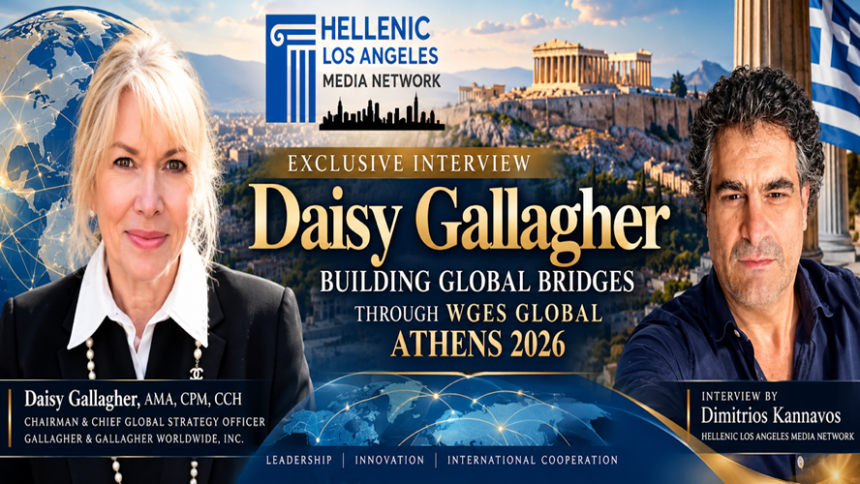


Daisy Gallagher is an internationally recognized executive, strategist, entrepreneur and senior advisor whose career spans the public and private sectors, strategic communications, business development, leadership, sustainability, science and international affairs.
As Chairman and Chief Global Strategy Officer of Gallagher & Gallagher Worldwide, Inc., Gallagher has built a distinguished professional career working across complex national and international environments, advising organizations and executives while developing strategic initiatives designed to connect people, institutions and ideas.
Her professional journey includes senior advisory and leadership roles involving the U.S. Navy League National Capital Council, the U.S. government and private sector, as well as executive advisory boards and international thought-leadership initiatives. She has also served as a Senior Advisor to DC Archangels Investors Group and as an Executive Advisor to organizations and leadership forums, including World Global, Inc. and the Thought Leadership Executive Level Think Tank.
Gallagher’s professional achievements have been recognized with more than 100 industry awards and recognitions. Among her distinctions, she has been named among the 100 Most Successful Women Around the World by the Global Trade Chamber and has received recognition associated with excellence in integrated marketing, agency leadership and strategic communications.
A member of the National Press Club in Washington, D.C., Gallagher has maintained a strong connection with the worlds of media, communications, government and international leadership. Her work reflects a multidisciplinary approach in which strategic thinking, communication, innovation and relationship-building come together to address complex challenges.
Her expertise also extends to global strategy, executive leadership, public-private cooperation, sustainability, women’s health, science and international partnerships. Through her work, Gallagher emphasizes the importance of bringing together government, academia, business, science and civil society to transform ideas into practical initiatives.
This international perspective is particularly relevant to WGES Global Athens 2026, where Gallagher is contributing to a major multidisciplinary platform bringing together leaders and experts from different sectors and countries.
Her relationship with Greece extends back more than two decades, beginning with her first visit to Athens in 2002. Since then, Greece has remained an important part of her personal and professional journey. Her return to Athens for WGES Global 2026 represents another chapter in a relationship shaped by international cooperation, academic engagement, cultural connections and a shared interest in building sustainable partnerships.
In this exclusive interview with the Hellenic Los Angeles Media Network, Daisy Gallagher discusses the vision behind WGES Global Athens 2026, the importance of international collaboration, the role of Greece as a meeting point between Europe and the wider world, the future of women in leadership, authentic communication, social impact, and her vision for the next decade of WGES Global.
At the heart of her message is a simple but powerful principle:
“Lasting progress is created when people from different disciplines and backgrounds come together, listen to one another and turn shared knowledge into meaningful action.”
Dimitrios Kannavos: Why was Greece chosen for the next international chapter of WGES Global?
Daisy Gallagher: First, let me say that we are grateful to be welcomed to Athens. WGES Global was invited here, and we accepted with a real sense of honor.
Since 2009 WGES Global has been hosted by the Governor of Pennsylvania and the Mayor of Philadelphia, by the Mayor and the University of the District of Columbia in Washington, the Governor of New York, and others.
The idea of Athens was a natural choice. The belief that government, science, academia and industry must reason together to solve shared problems has its roots here.
Athens also stands at the crossroads of Europe, the Mediterranean and the wider world, with real leadership in maritime affairs, public health and innovation.
Dimitrios Kannavos: What is the central message you want WGES Global Athens 2026 to deliver?
Daisy Gallagher: That the challenges in front of us are too large for any one sector or any one country to solve alone.
Energy, public health, climate resilience, food systems and the workforce of the future do not respect borders or organizational charts. Progress happens when officials, academia, scientists and executives sit at the same table, listen to one another and leave with something to do.
That is what WGES Global has done for nearly two decades, and it is what we hope Athens 2026 will do: move from knowledge exchange to practical collaboration.
Dimitrios Kannavos: How can this multidisciplinary platform create concrete international partnerships?
Daisy Gallagher: By designing for outcomes from the start. The right people have to be in the room, the program has to be built around real problems, and the relationships have to continue after the final session.
That work began months ago. It started with a press briefing at the National Press Club in Washington and continued with the Executive Academic Leadership Forum hosted by the University of West Attica here in Athens.
The academic program is anchored by our co-host, the UNIWA School of Public Health, led by Dean Professor Elpida Pavi, with Professor Georgios I. Zakynthinos as Academic Coordinator, together with Professor Yiannis Koumpouros, Professor Georgios Priniotakis, Associate Professor Anastasios Sepetis, Assistant Professor Olga-Eleni Astara and Assistant Professor Michalis Skordoulis.
Our co-host Nazionale Piloti / Safe-Drive.org brings road safety and international partnership to the program.
The WGES Global leadership, under our President and Executive Chairman, Professor Robert J. Gallagher, works hand in hand with the Greek Organizing Team, including Dr. Kostas Mastorakis, our Athens Ambassador and Vice President of Nazionale Piloti, Professor Zakynthinos and Nikoletta Anagnostopoulou Bakalarou.
With the support of Hellenic Media and our media partners, that collaboration is itself the first partnership Athens 2026 has produced. We intend it to be far from the last.
Due to the pre-planning process, relationships have been built and collaboration has already been in the works for projects even prior to the official start of WGES Global Athens 2026. We anticipate more collaboration for those who participate once the sessions commence.
Dimitrios Kannavos: What convinced you that now is the right time to bring WGES Global to Athens?
Daisy Gallagher: I was first invited to Athens in 2002 by the Euro-American Women’s Council, while I was serving on the executive committee of Women Impacting Public Policy in Washington, D.C., as the city was preparing for the 2004 Olympic Games.
In the years since, I have watched Athens renew its infrastructure, modernize public services, strengthen its commitment to sustainable projects, and attract a new generation of entrepreneurs and innovators. The city has shown remarkable resilience and confidence.
What convinced me the time was right was the invitation. Also the academic leadership at the University of West Attica, the commitment of the most amazing WGES Global Greek Organizing Team, and the support of others.
Dimitrios Kannavos: What would you like the lasting legacy of WGES Global Athens 2026 to be?
Daisy Gallagher: I would like the legacy to be a lasting bridge.
That means academic collaborations that continue, joint research and increased workforce development for these disciplines, partnerships between companies and institutions that met for the first time in Athens, and young professionals who leave with mentors and a network.
In America, WGES Global programs led to relationships that lasted for years after each symposium. If, five years from now, people can point to projects and friendships that began in Athens in October 2026, we will have done our job.
Dimitrios Kannavos: What is the most important lesson you have learned about public-private cooperation?
Daisy Gallagher: Trust is built before it is needed. The public and private sectors speak different languages, work on different timelines and answer to different stakeholders. Cooperation succeeds when each side takes the time to understand the other’s constraints and responsibilities.
Serving on the U.S. General Services Administration Industry–Government Council and the U.S. Small Business Advisory Council in Washington, D.C., I saw that the best outcomes came from people who listened first, respected the public trust, and kept their commitments. Respect and reliability are what make partnership possible.
Dimitrios Kannavos: What is the greatest challenge organizations face when implementing large-scale international projects?
Daisy Gallagher: Alignment. Most projects do not fail because of a lack of talent or resources. They fail because the people involved have different understandings of the goal, the timeline or their own role.
Internationally, that challenge is multiplied by language, culture, law and custom. The answer is clear communication, shared objectives agreed at the start, and genuine respect for local knowledge.
When we led executive program management for the Office of Personnel Management (OPM) workforce training sessions, an intensive program with general sessions and 250 breakout sessions, success depended on every team understanding not only what to do but why it mattered. The same is true in Athens.
Dimitrios Kannavos: What does authentic and credible leadership communication mean today?
Daisy Gallagher: It means saying what you will do, doing what you said, and being willing to be measured by it. Credibility is not built through volume. It is built through consistency over time.
My training has taught me that people respond not only to words but to intention, tone and presence. Much of how we decide happens below the surface. Authentic communication respects that. It is clear, it is honest, and it treats the listener as a partner, not an audience.
Dimitrios Kannavos: Should social impact be an integral part of modern business strategy?
Daisy Gallagher: Yes. The most durable businesses have always understood that their success depends on the health of the communities, workforce and environment around them. What has changed is that investors, employees and governments now expect it.
In biotechnology for women’s health and in sustainability, impact and value are not in tension. They reinforce one another. Companies that treat social impact as part of their strategy, not as a separate program, are the ones that will earn trust and endure.
Dimitrios Kannavos: What distinguishes a genuine thought leader from someone who simply has public visibility?
Daisy Gallagher: A genuine thought leader changes how other people think and act. Visibility is about being seen. Thought leadership is about being useful.
When we created the Think Tank Series with the Council of Federal Executives, we brought together leaders from the U.S. Department of Defense, the U.S. Air Force Academy, the Office of Personnel Management, Merck and Weyerhaeuser with faculty from Fordham, NYU and Cornell.
The people who made the greatest contribution were not the loudest. They were the ones who asked the best questions, shared what they had learned, including their mistakes, and left others better equipped.
Dimitrios Kannavos: What is the first quality you look for in a new international partnership?
Daisy Gallagher: Integrity: shared values and a sincere commitment to the mission. Capabilities can be built and resources can be found, but a partnership without shared values will not last.
I look for partners who keep their word, who respect the people and places they work with, and who are in it for the long term. That is exactly what we found in the University of West Attica School of Public Health and the WGES Global Athens Greek Organizing Team.
Dimitrios Kannavos: Is there a particular experience or person in Greece that influenced the way you see the country?
Daisy Gallagher: The connection began long before my first visit. I grew up in Astoria, New York, known as “Little Athens,” so the culture was part of my life from childhood.
This year marks my twentieth visit, and what stays with me most is the people. Everyone I have met has shown great kindness. As a person of faith, I am also moved by the depth of faith so evident here.
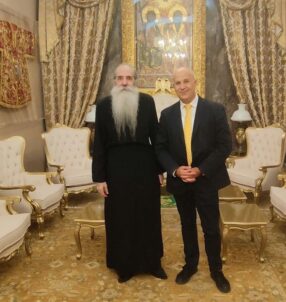
One person who is very special to many, and whom I have the privilege of knowing, is Elder Georgios Alevras of Mount Athos. He and his spiritual children do wonderful work for community and sustainability in honor of Our Lady of the Bees, and he is a WGES Global NOVA Award recipient.
In September 2025, I was honored to present at the tribute to the Governor, Ioannis Kapodistrias, at the War Museum of Athens, where Elder Georgios and Yannis Smaragdis, director of the film Kapodistrias (The Governor), gave the principal addresses.
That evening I learned the story of a true hero who gave his life in service of his people and their democracy.
Dimitrios Kannavos: Is there one recognition that holds particularly special personal meaning for you?
Daisy Gallagher: It is very difficult to separate one from another. I am humbled by every organization that has recognized our work in business, government and community service, and I take each one seriously.
Whether it came from a President, the Congress or a Governor, from industry or a chamber of commerce, from a community organization, or internationally from organizations here in Athens, I treasure them all.
Each one is a testament to the network of excellent people, from the local level to the international stage, whom I have had the privilege to know and work with. It is never one person. It is always a team that makes the path to a successful outcome.
Dimitrios Kannavos: What do you see as the greatest challenge and opportunity for women in leadership today?
Daisy Gallagher: The greatest challenge is still access: access to capital, to the rooms where decisions are made, and to the networks that open doors. Women are often well prepared but not yet invited.
The greatest opportunity is that the problems the world now faces, in health, sustainability and technology, reward exactly the qualities women so often bring: collaboration, long-term thinking and the ability to build consensus.
I have always believed that success is the friend of the communicator and the consensus builder. My advice to young women is to be excellent, be prepared, and when you reach the table, bring others with you.
Dimitrios Kannavos: What is your vision for the next decade of WGES Global?
Daisy Gallagher: From Philadelphia to Washington, New York and now Athens, WGES Global will continue to be the trusted table where government, science, academia and industry come together across borders to turn shared knowledge into practical solutions for a healthier, more sustainable world.
Related Post




Leave a comment